Reading the Report: How Oil Analysis Flags Liner Trouble Before You Hear It
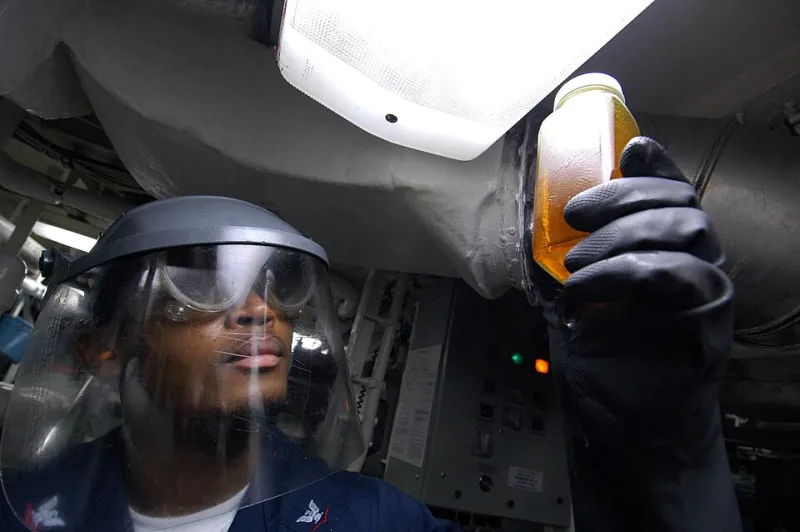
Photo: U.S. Navy photo by Photographer's Mate Airman Patrick L. Heil, Public domain, via Wikimedia Commons
Most liner engines don't fail with a bang. They fail with a slow, polite decline that everyone ignores until the head's off and the block's on the bench. By then you're into a rebore, a set of pistons and a conversation with your other half about why the garage smells of coolant again.
An oil sample costs somewhere between twenty-five and forty quid posted off to a lab. That's roughly one tank of diesel. It won't rebuild anything, but it will give you a paper trail of what's happening inside the block — and on a fresh liner build, that's genuinely useful evidence rather than a hunch.
Why ears aren't enough
The classic diagnostic toolkit is a stethoscope, a compression gauge and a nose for burning coolant. All fine. All late. A compression test tells you the rings aren't sealing now; it doesn't tell you whether the iron in your sump has been climbing for the last four thousand miles. Wear metals in oil are a trend, and trends show you the direction of travel while there's still time to act.
This matters most on two types of engine. First, the freshly rebuilt liner job — you want to know within the first thousand miles whether the bore finish, ring pack and sealant work are behaving. Second, the old workhorse: the Perkins in the tractor, the Td5 in the Defender, the Cummins in the van that's done 180,000 miles and is due a decision.
Pulling a sample that's worth testing
Half the disappointing oil reports in the UK aren't the engine's fault — they're the sampling. A few rules:
- Get the oil hot. A twenty-minute run, not a two-minute idle. Contaminants settle in a cold sump and you'll sample clean oil sitting on top of dirty oil.
- Sample mid-drain, not first or last. First flow carries the sludge you don't want to over-represent; the last dregs carry the panic. Mid-stream is the honest middle.
- Use a proper vacuum pump or a clean bottle. Not a jam jar, not a rinsed milk bottle, not the sample tube you used last time. Trace contamination will give you a false aluminium or silicon reading and send you chasing ghosts.
- Label it properly. Hours since last oil change, oil brand and grade, top-up volumes, and whether the engine has done mostly motorway or mostly Tesco car park.
- Be consistent. Same point in the drain, same interval, same lab. A one-off report is a curiosity; three in a row is a diagnosis.
On a fresh liner rebuild, pull the first sample at around 500 miles — that's your break-in baseline, and it will look grim with iron and silicon because everything is bedding in. Ignore that number in isolation. The second sample at 2,000–3,000 miles is where the story starts.
The metals that actually matter
Labs report a long list of elements and it's easy to glaze over. On a liner engine, these are the ones to read first.
Iron. Your headline number. Liners, rings, camshaft, tappets, timing gears — iron comes from all of them. A gentle rise with mileage is normal. A step change between two samples on the same oil interval is not. If iron doubles while nothing else has changed, the bore finish or ring seal is worth a look.
Chromium. Top ring face on many sets. Rising chrome with rising iron is the classic pairing of bore and ring wear working together.
Aluminium. Pistons, and on some engines the head or timing cover. Small numbers are boring. A jump alongside silicon usually means dirt is getting past the filter or the intake.
Copper, lead and tin. Bearings, thrust washers, and on older engines the shell material. On a liner job these are less about the bores and more about whether the bottom end is unhappy with the fresh top end. Worth watching, not worth panicking over at 15 ppm.
Silicon. The dirt marker — but also a coolant marker on some antifreeze formulations. Context is everything: high silicon plus high aluminium plus a dusty farm track is ingestion. Same numbers on a road car with a sealed intake points you toward the coolant side.
Potassium and sodium: the wet-liner tell-tales
If your engine has wet liners, this is the section that earns the thirty quid back.
Coolant contains potassium (in many OAT and hybrid OAT formulations), sodium, boron, and sometimes silicates depending on the chemistry. When a liner seal or an O-ring starts weeping — not enough to leave a puddle, just enough to migrate past the seating ring — those elements turn up in the oil before the coolant level in the header tank ever looks suspicious.
A potassium or sodium figure that was steady at single digits and is now in the thirties or forties, alongside a slightly rising silicon, is your early warning. It doesn't prove the seal has gone. It proves something coolant-shaped is getting into the sump, and on a wet-liner block there are only so many places it can come from.
Catch it at that point and you're looking at a seal set and a weekend. Ignore it for another six months and you're looking at a liner sitting in a bath of diluted coolant, a scuffed bore, and a block that needs machining. The maths isn't close.
Watch the physical properties too
Viscosity, water content, fuel dilution and total base number aren't as glamorous as metals but they change the interpretation. A viscosity that's dropped out of grade plus rising fuel dilution tells you the oil is being thinned by short winter commutes and the wear metals you're seeing are partly a lubrication problem, not a metallurgy problem. Water at 0.2% on a diesel that does five miles to the station and back is a condensation story. Water at 1% plus potassium is a coolant story.
That distinction matters because one is fixed by a longer run and a thermostat, and the other is fixed by taking the head off.
Build the file, then use it
Keep every report in the build folder. Three consecutive samples with a rising iron trend and a potassium spike is a far more persuasive document than your opinion, whether you're talking to a customer, a machinist, or a warranty department. It's also remarkably good at stopping you from pulling a perfectly healthy engine apart because someone on a forum said the noise sounded like big ends.
And if the report comes back clean, that's not wasted money. That's a baseline — the number you'll compare everything else against for the next hundred thousand miles.
The bottom line
Oil analysis isn't a substitute for a sonic test, a torque plate hone or a proper liner protrusion check. It's the cheap, repeatable check between the big ones. On a wet-liner engine with a fresh seal job, or an ageing block you're trying to justify saving, it's the closest thing to a warning light that tells you the truth.
Thirty quid, a hot engine and a clean bottle. Cheaper than a rebore, every time.