Bubbles That Bite: The Wet-Liner Cavitation Check Your Coolant Is Begging For
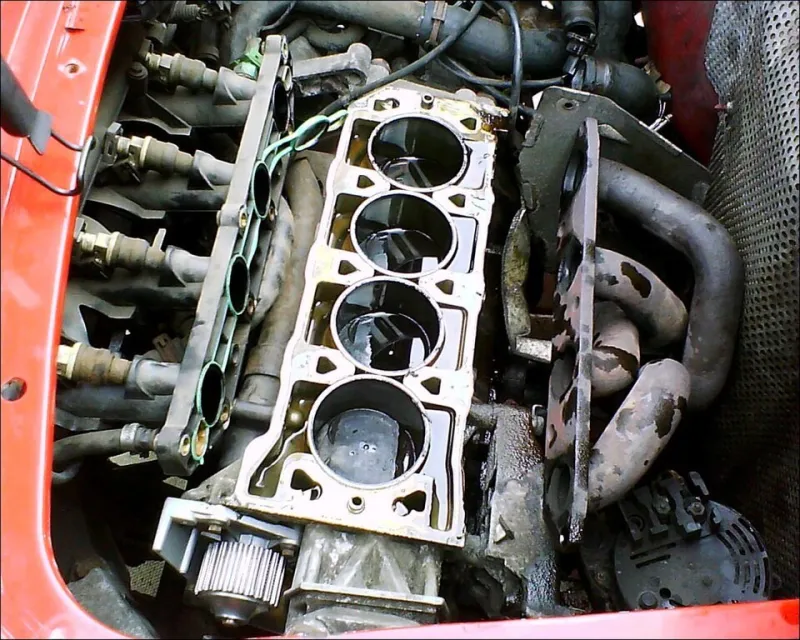
Photo: Nibi, Public domain, via Wikimedia Commons
Cavitation is one of those faults that feels almost unfair. The head gasket is fine. The liner seals are not leaking. The engine may even run sweetly. Yet on the hidden, coolant-facing side of a wet liner, tiny vapour bubbles are collapsing against the metal thousands of times a minute and nibbling it away. By the time there is a coolant loss, a misfire or a creamy emulsion in the sump, the damage has often moved from “annoying” to “new block required”.
For UK diesel owners and engine builders, this is worth taking seriously. Our short journeys, long idle periods, stop-start traffic and occasional habit of topping up with whatever is in the garage do not create cavitation on their own — but they can make a marginal coolant system worse. The liner is the innocent party.
Why the Outer Wall Takes the Hit
A wet liner has coolant directly on its outside. That is brilliant for heat transfer and less brilliant for protection. Combustion pressure makes the liner flex and vibrate very slightly. Those pulses travel through the coolant, creating low-pressure zones where vapour bubbles form and then collapse. The collapse is violent on a microscopic scale, firing a jet of coolant at the liner wall. Repeat that enough times and you get pitting: small craters that can join into a honeycomb, then into a hole.
It is not the same as rust. Corrosion tends to look like general staining, scale or a rough wash of oxide. Cavitation pitting is localised, often clustered, and can look surprisingly clean around the edges. On a used liner, the damage is usually below the top area and around the section that sits in the coolant jacket, sometimes favouring the thrust side or the hottest parts of the liner. The exact pattern depends on the engine, but the lesson is always the same: the bore looks fine while the outside is being eaten.
What You See When the Liner Comes Out
Inspection starts with cleaning, but not with a wire brush and enthusiasm. Aggressive cleaning can round off the edges of pits and make terminal damage look mild. Use a proper parts washer or a soft method, dry the liner, then inspect under good light with a magnifier. A small pick can help you judge depth, but do not dig at every mark.
Mild pitting is usually scattered pinpricks, dark specks or shallow craters that do not break through. Photograph it with a scale beside it and note the location. Moderate pitting is clustered, with a sandblasted or honeycombed look and visible depth. Terminal pitting is the point where craters join, the wall is visibly thin, or you can see staining that suggests coolant has crossed the liner wall. At that stage, do not polish it and hope. Replace the liner and find out why the coolant was not protecting it.
Check the whole liner, not just the side you can see first. Look at the sealing areas, the lower land and the coolant jacket side of the block as well. If one liner is pitted, inspect the rest. Cavitation rarely sends a polite invitation to only one cylinder.
Test Strips and the Coolant Clues
Coolant is the cheap diagnostic. A refractometer will tell you the glycol concentration, which matters for both freezing and boiling protection. Test strips can give you pH, reserve alkalinity and, depending on the chemistry, indicators for inhibitors such as nitrite or molybdate. Use strips designed for the coolant type you actually have, and read them at the right temperature and timing. A strip that has been in a glovebox since the last decade is not a diagnostic tool.
What are you looking for? A coolant that is acidic, exhausted or diluted has less ability to inhibit the cavitation process. If the manufacturer specifies a coolant with cavitation protection for a wet-liner diesel, do not substitute a generic ready-mixed product just because it is the right colour. Colour is not a specification. Mixing coolant chemistries can also drop the inhibitor package out of solution or reduce protection, so if you do not know what is in the system, drain, flush and refill with the correct product.
UK water is another quiet offender. Hard water and tap water top-ups can leave scale and chlorides in the system. Mix concentrated coolant with deionised or demineralised water where possible, and do not treat a litre of tap water every month as “just maintenance”.
Prevention in a UK Workshop
Start with the cooling system as a whole. A weak pressure cap, a leaking hose or a failed thermostat can cause local hot spots and air pockets, and air is not a coolant. Pressure-test the system, check the cap, bleed it properly and make sure the heater matrix and expansion tank are doing their jobs. After a rebuild, fill with the correct coolant mix, bleed thoroughly and label the system so the next owner knows what is in it.
For engine builders, the liner fit matters too. Correct protrusion, clean counterbores, the right sealant and a properly prepared block all help the liner sit and cool as intended. A poorly supported liner can flex more, and more flex is more cavitation energy. It is not a substitute for coolant chemistry, but it is part of the same story.
Finally, make coolant checks a service item rather than a post-mortem. A two-minute strip test and a visual check of the expansion tank can flag a problem while the liner is still saveable. If you are buying a used UK diesel with wet liners, ask when the coolant was last changed and look for mixing marks, muddy residue or a weak cap. The bore may look honest. The outer wall is where the truth lives.