Bores Don't Lie: A Workshop Autopsy for Failed Cylinder Liners
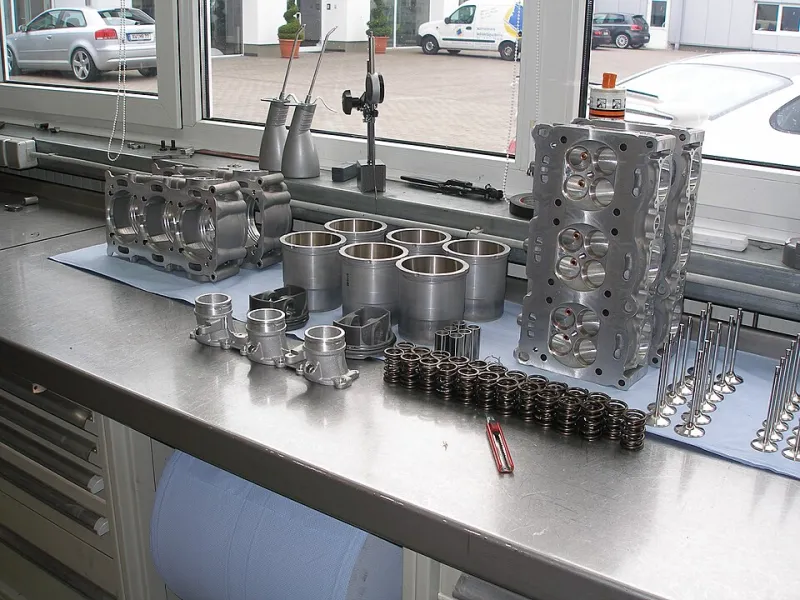
Photo: Roman Boed from The Netherlands, CC BY 2.0, via Wikimedia Commons
A failed liner is rarely just a failed liner. It is a receipt for something that went wrong earlier: a coolant leak you didn't spot, a filter doing less than you thought, a hone that looked lovely under the sodium light but wasn't right, or a bit of blasting grit that found its way into the wrong place. If you simply bin the old liner and fit a new one, you're guessing. If you read it properly, the bore will usually tell you what happened.
This isn't about turning every teardown into a CSI episode. It's about slowing down for twenty minutes, keeping the evidence intact, and asking a few blunt questions before the block goes back to the machinist.
Keep the crime scene intact
The most common mistake is cleaning everything before anyone has looked at it. A liner wiped down with brake cleaner has lost a lot of its story. Oil staining, coolant residue, carbon patterns and the exact position of marks all matter.
Before you strip the block, label each piston and liner by cylinder. Take photos from the top, the bottom and both sides of the bore. If it's a wet liner, photograph the outside as well as the inside, especially around the seals and the seat. Bag the shell bearings and note their condition — they often corroborate what the bore is saying. Then, and only then, start cleaning.
Scoring: something hard has been through there
Vertical scores that you can catch with a fingernail usually mean debris. The question is where it came from. A score confined to one side of the bore often points to piston thrust loading pushing a trapped particle into the wall. Scores around the whole bore suggest air filtration trouble, a dirty build, or breakdown debris from a failing component upstream.
Look at the piston skirt and crown as well. If the skirt is heavily marked, the piston has been rocking or the clearance was wrong. If the crown has impact marks, you may have a valve or injector issue adding metal to the party. On UK road cars, short journeys and clogged breathers can also leave enough emulsion and carbon to cause bore wear that looks like poor filtration when it's really poor servicing.
Scuffing and smearing: heat and lubrication
Scuffing looks like torn, smeared aluminium transferred onto the liner wall. It's often accompanied by piston skirt damage and a general overheated look. This is a lubrication and thermal problem, not a debris problem. Causes include overheating, incorrect piston-to-bore clearance, wrong ring tension, a lean mixture, or an engine that was thrashed before it had oil pressure.
On a fresh rebuild, scuffing in the first few hundred miles is a red flag for honing, clearance or warm-up procedure. On a high-mileage engine, it may simply be the end of a hard life. Either way, don't just re-hone and hope. Check the cooling system, the oil pump, the piston cooling jets if fitted, and the ECU fuel trims if it's a modern diesel.
Pitting and corrosion: the coolant conversation
Pitting inside the bore is usually a coolant story. Small pits clustered near the top of the liner can come from combustion gases leaking past the head gasket or from steam getting where it shouldn't. Pitting lower down, especially on a wet liner's outside, points to coolant condition and cavitation.
Cavitation erosion looks like a series of little craters on the wet side of the liner, often near the piston's thrust area. It's caused by coolant vapour bubbles collapsing against the liner wall. In UK service, the usual suspects are old coolant, wrong coolant, a weak pressure cap, airlocks after a repair, or a radiator that's seen better days. If you find cavitation, don't just replace the liner — flush the system, pressure-test it, and check the water pump and thermostat housing.
Cracks: where and why
A crack at the liner flange or top seat is often an installation issue: distorted seat, incorrect protrusion, over-tightened head bolts, or a block deck that wasn't clean and flat. A crack running down the bore is more serious and may indicate a hydraulic lock, severe overheating, or a casting flaw. On wet liners, cracks around the seal grooves can come from pitting and repeated seal replacement without checking the groove condition.
If you find a crack, stop. Don't assume a new liner will fix it. The block deck, the head face and the liner seat all need checking with a straight edge and a dial gauge before any money is spent.
The post-mortem checklist
Before the block goes back to the machinist, run through this:
- Photograph and label every liner, piston and bearing shell by cylinder.
- Note the exact position and type of every mark: vertical score, scuff, pit, crack, cavitation.
- Check the outside of wet liners for seal damage, pitting and staining.
- Measure bore wear with a dial bore gauge at top, middle and bottom, in two planes.
- Check piston skirt clearance and ring end gaps.
- Inspect the air filter, intake tract and breather system for debris paths.
- Pressure-test the cooling system and inspect coolant condition.
- Check deck flatness and liner protrusion before ordering parts.
- Write down your conclusion — even if it's "inconclusive" — and keep it with the rebuild file.
Don't rebuild blind
The whole point of reading a failed liner is to avoid paying twice. A scored bore from grit, a scuffed bore from heat, and a pitted bore from coolant all need different fixes. Fit a new liner without addressing the cause and you'll be back at the same bench with the same problem and a lighter wallet.
Treat the old liner as evidence, not scrap. It won't tell you everything, but it will usually tell you enough to ask the right questions before the next rebuild goes together.